
Fig
A soft, honey-sweet fruit with tiny crunchy seeds inside a thin purple, green or golden skin. Figs are eaten fresh, dried, baked and made into jam.
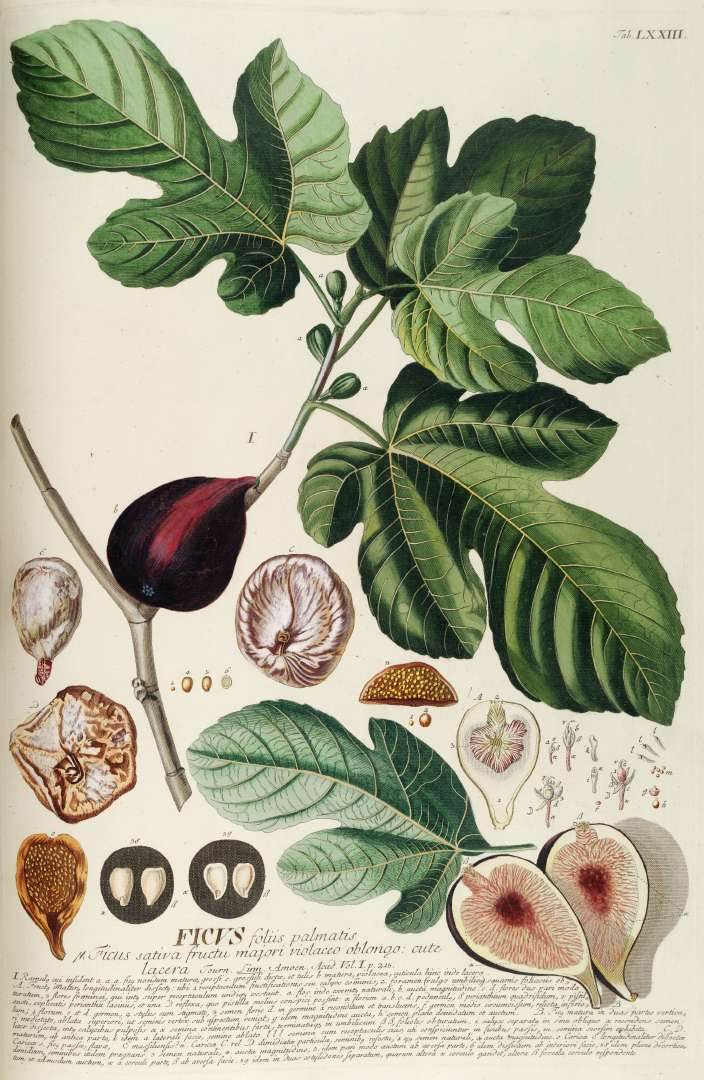
Ficus carica L, 1771: Trew, C.J, Public domain (Wikimedia Commons)

Where it comes from
Figs have grown around the Mediterranean and Anatolia since ancient times, and Turkiye is one of the world's leading fig producers, especially the Aydin region. Dried figs are a familiar sweet and travel snack from Turkiye across the Middle East.
Explore the cuisine of Türkiye.
Nutrition: Figs are a natural source of fiber, potassium and calcium.
Enjoying Fig
Ways to enjoy it
- Fresh with cheese and honey
- Sliced over yogurt or oatmeal
- Stuffed with walnuts or almonds
- Dried and chopped into baked goods
- Simmered into jam or compote
- Roasted with honey and thyme
- Served alongside soft cheese
How to choose, prepare and store
- Choose figs that are plump, soft to the touch and slightly drooping at the stem; avoid ones that are hard or leaking.
- Handle gently, since ripe figs bruise easily.
- Rinse briefly and pat dry; trim the stem.
- Eat whole with the skin on, or slice in half to show the pink interior.
- Store ripe figs in a single layer in the refrigerator for up to 3 days.
- For dried figs, keep in an airtight jar in a cool place for several months.
Variations
- Black Mission figs: Dark and rich.
- Smyrna figs: Golden and nutty, common in Turkiye.
- Dried fig strings: A traditional treat.
Cook’s tip: Eat figs the day you buy them; they do not ripen after picking.
Also on the menu in
- Albania
- Algeria
- Azerbaijan
- Bahrain
- Bosnia and Herzegovina
- Croatia
- Cyprus
- Egypt
- Gibraltar
- Greece
- Iran
- Iraq
- Israel
- Italy
- Jordan
- Lebanon
- Libya
- Malta
- Montenegro
- Morocco
Related dishes
Description and method written by Intercontinental Chef. Home-style method; quantities are a starting point, so adjust to taste.
- Ficus carica L, 1771: Trew, C.J, Public domain (Wikimedia Commons)