
Turkish delight
Soft, chewy cubes of sweet starch jelly flavored with rose, lemon or orange and often studded with nuts, then dusted with powdered sugar. They are delicately sweet and meltingly tender.
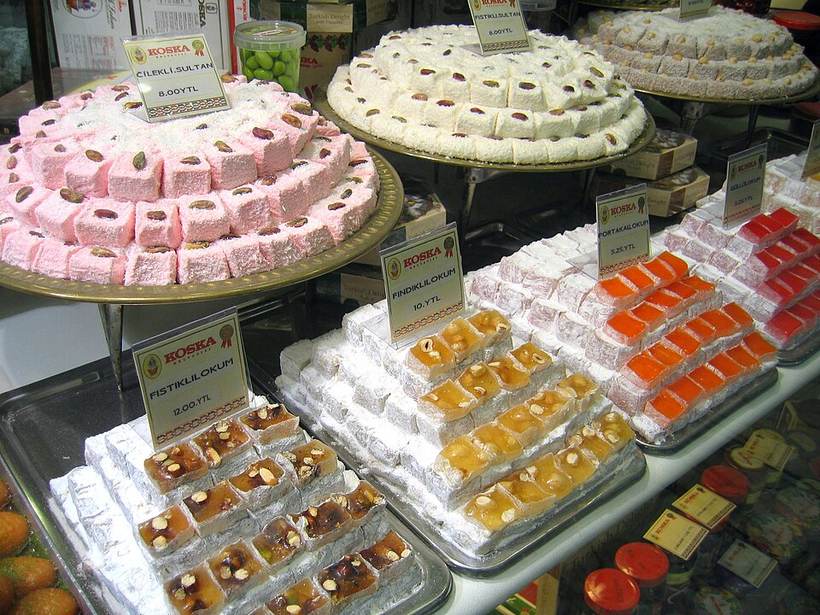
TurkishDelightDisplay: Quick fix, CC BY-SA 2.0 (Wikimedia Commons)

Where it comes from
Lokum has been made in Turkiye for centuries and was improved in the 1700s and 1800s when sugar and starch became widely available. It is served with coffee and tea and given as a welcome gift, and it is popular across the Middle East and the Balkans.
Explore the cuisine of Türkiye.
Make Turkish delight at home
Ingredients
- 3 cups sugar
- 4 cups water, divided
- 1 tsp lemon juice
- 1 cup cornstarch
- 1/2 cup powdered sugar, plus extra
- 1 tsp cream of tartar
- 2 tbsp rose water
- A few drops of red food coloring
- 1/2 cup chopped pistachios
How it's made
- Boil the sugar, 1 1/2 cups water and lemon juice to 240F (soft ball) and set aside.
- In another heavy pot whisk the cornstarch, cream of tartar and remaining 2 1/2 cups water until smooth.
- Cook the starch mixture, whisking, until it becomes thick and translucent.
- Slowly whisk in the sugar syrup and simmer over low heat, stirring, for about 1 hour until pale gold and very thick.
- Stir in the rose water, color and pistachios.
- Pour into a pan lined with a dusted sheet and let it set uncovered overnight.
- Cut into cubes and toss in a mix of powdered sugar and cornstarch.
Variations
- Rose lokum: The classic pink cubes.
- Lemon or mint lokum: Light and refreshing flavors.
- Double roasted lokum: Packed with hazelnuts or pistachios.
Cook’s tip: Stir the mixture constantly and cook until it holds a ribbon; undercooked lokum will be too soft to cut cleanly.
Related dishes

Description and method written by Intercontinental Chef. Home-style method; quantities are a starting point, so adjust to taste.
- TurkishDelightDisplay: Quick fix, CC BY-SA 2.0 (Wikimedia Commons)